


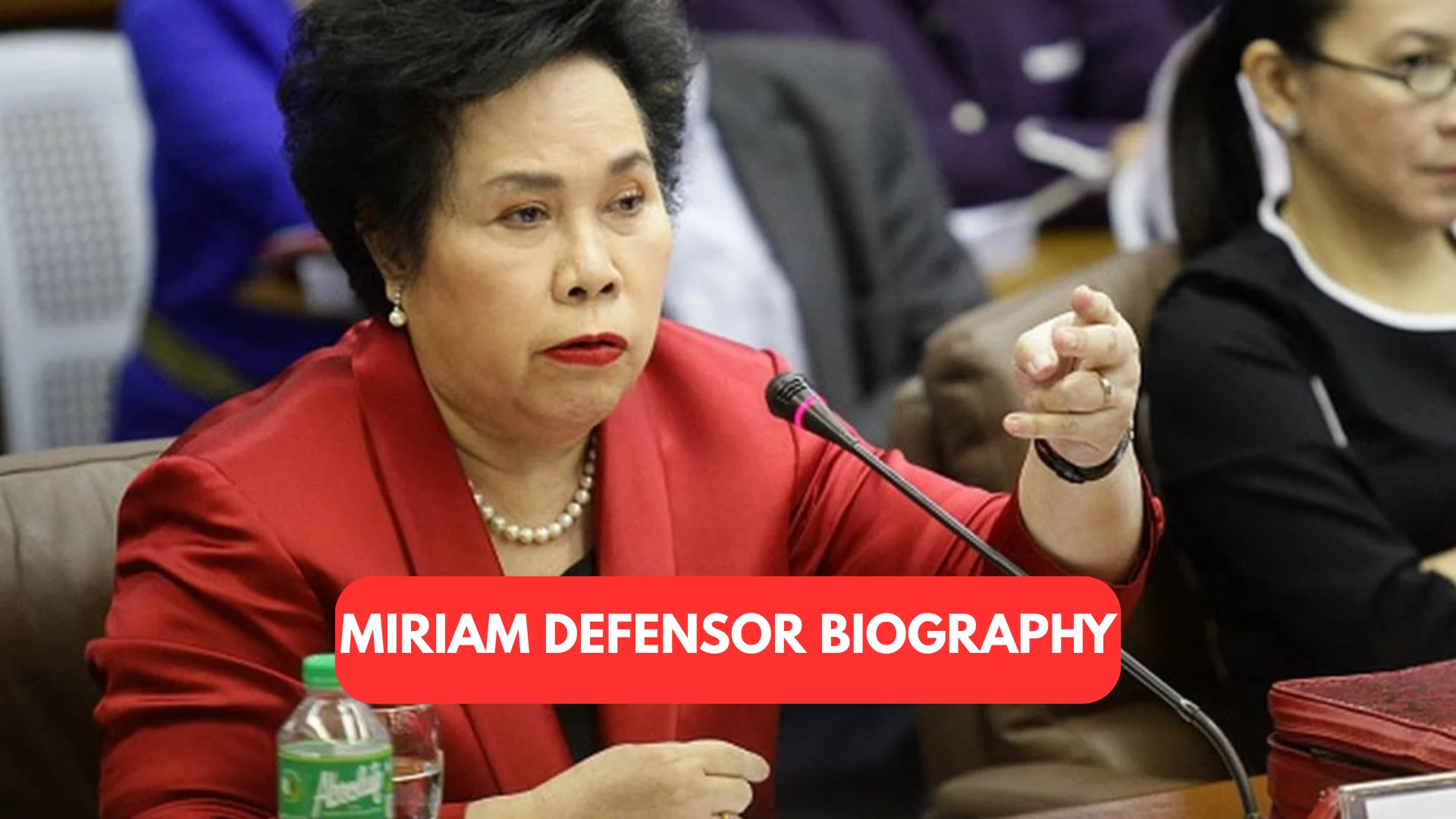
Miriam Defensor Santiago stands as one of the Philippines’ most revered public servants — a scholar, lawyer, judge, and politician whose influence spanned decades and whose legacy continues to inspire generations.
Known globally as the “Iron Lady of Asia,” she broke barriers, fought corruption, and championed legal and social reforms in a nation often marred by political challenges. In this comprehensive biography, we explore her life from humble beginnings to becoming a national icon, detailing her background, accomplishments, challenges, and her enduring impact on Filipino society.
Early Life and Education
Born on June 15, 1945, in Iloilo City, Philippines, Miriam Palma Defensor was raised in a household that valued education and integrity. Her father, Benjamin A. Defensor, was a district judge, and her mother, Dimpna Palma-Defensor, was a schoolteacher. From the outset, Santiago demonstrated academic excellence, graduating as valedictorian in elementary, high school, and college — achievements that foreshadowed her brilliant career.
She attended the University of the Philippines, graduating magna cum laude with a Bachelor of Arts in Political Science in 1965. She then pursued law at the University’s College of Law, where she excelled academically, became a top debater, and made history as the first female editor-in-chief of the prestigious Philippine Collegian student newspaper. Following her law degree, she earned advanced legal degrees — including a Master of Laws and a Doctor of Juridical Science from the University of Michigan in the United States — solidifying her reputation as a legal prodigy.
Career: A Life in Service
Miriam Defensor Santiago’s career spanned all three branches of government — judicial, executive, and legislative — a rare feat that few public officials achieve.
Judicial Career
Santiago began her public service as a presiding judge of the Regional Trial Court in Quezon City, earning a reputation for strict impartiality and efficiency. Known for her refusal to tolerate delays or bribes, she set a high standard for judicial conduct.
Executive Roles
In the executive branch, she served as the Commissioner of Immigration and Deportation and later as Secretary of Agrarian Reform. In these roles, she aggressively fought corruption, streamlined bureaucracy, and pursued reforms that emphasized public accountability.
Legislative Leadership
Miriam Defensor Santiago was elected to the Senate of the Philippines for three terms, where she became known for her bold leadership, sharp intellect, and fearless advocacy against corruption. She chaired several key committees, including the Committee on Foreign Relations and the Committee on Constitutional Amendments. Her legislative agenda included landmark laws on public health, environmental protection, and governance reforms.
Her legislative efforts included authorship or sponsorship of major laws such as the Climate Change Act, Sin Tax Law, Renewable Energy Act, and the Magna Carta of Women, all of which have had lasting positive impacts on Filipino society.
International Recognition
In 2011, Santiago made history as the first Filipino and first Southeast Asian elected as a judge of the International Criminal Court (ICC) — a prestigious role that reflects her global stature as a legal authority. Although she later waived this position due to health concerns, this achievement marked a high point in her distinguished career.
She was also honored with numerous awards, including the Ramon Magsaysay Award for Government Service, often dubbed Asia’s equivalent of the Nobel Prize, recognizing her bold leadership and integrity in public service.
Personal Life
Outside of politics and the law, Miriam Defensor Santiago was a devoted wife and mother. She married Narciso “Jun” Santiago Jr., and together they raised their family. Despite personal heartbreak, including the tragic loss of one of her sons, she continued her work in public service with resilience and strength.
Her personal experiences shaped her worldview and fueled her passion for justice — qualities that endeared her to many Filipinos.
Battle with Illness and Later Life
In June 2014, Santiago was diagnosed with stage 4 lung cancer — a battle she faced with courage and humor. She publicly shared her health journey, offering hope and inspiration to many as she fought the disease with unwavering determination.
Despite her illness, she remained engaged in public discourse and even ran for the presidency in 2016, showcasing her enduring commitment to serving the Filipino people.
Legacy and Impact
Miriam Defensor Santiago’s legacy is profound. She redefined what it means to be a public servant in the Philippines — blending intellect, courage, and integrity in a career dedicated to reform and accountability.
Her contributions to law, governance, and public policy continue to influence Filipino society. From her bold legislative initiatives to her legacy of fearless public service, Santiago remains an emblem of principled leadership and national pride.
Frequently Asked Questions (FAQs)
Who was Miriam Defensor Santiago?
Miriam Defensor Santiago was a Filipino lawyer, judge, academic, and politician known for her service in all three branches of the Philippine government.
What were her major achievements?
She served as a senator, presiding judge, immigration commissioner, agrarian reform secretary, and was elected as a judge of the International Criminal Court.
Why is she called the Iron Lady of Asia?
She earned this title for her fierce stance against corruption, her legal brilliance, and her no-nonsense leadership in government.
Did she ever run for president?
Yes, Santiago ran for the presidency of the Philippines multiple times, including in 2016.
What is her legacy today?
Her legacy includes landmark legislation, institutional reforms, and a model of ethical public service that continues to inspire leaders and citizens alike.
Conclusion
Miriam Defensor Santiago’s life was one defined by unwavering dedication to justice, courage in the face of adversity, and an unrelenting commitment to her country. Her remarkable journey from a young scholar in Iloilo City to becoming one of the Philippines’ most respected stateswomen serves as a testament to her brilliance, resilience, and legacy. Through her work, she not only transformed the landscape of Philippine politics and law but also inspired countless individuals to pursue integrity and excellence in public service. Her legacy will continue to shine as a beacon of hope and integrity for generations to come