

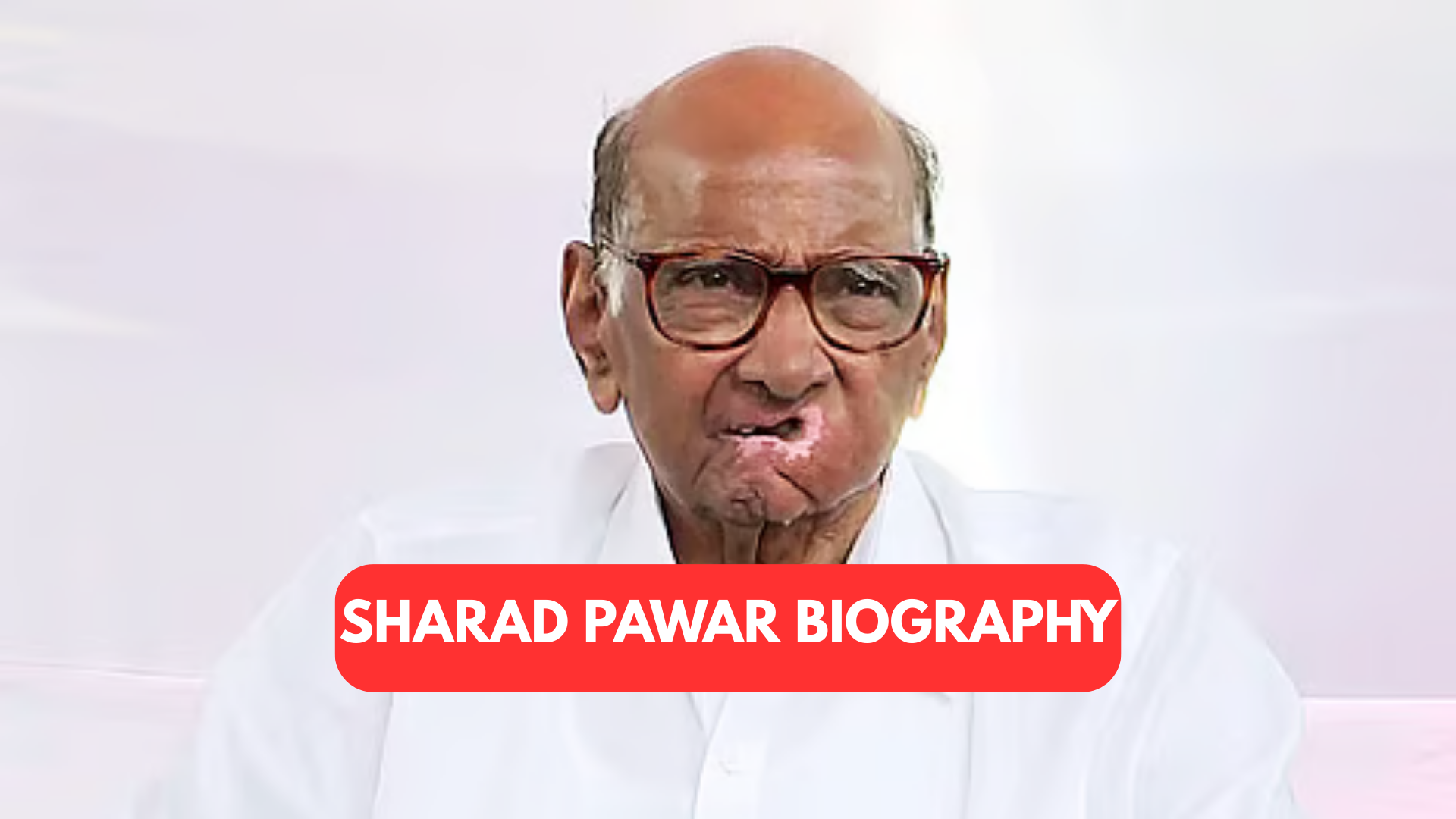
Sharad Govindrao Pawar is one of the most influential and enduring political figures in India’s modern history. With a career spanning over five decades, Pawar has shaped state and national politics through leadership, strategy, and resilience.
From becoming one of the youngest Chief Ministers of Maharashtra to founding the Nationalist Congress Party (NCP), his journey reflects both triumphs and controversies.
Early Life and Family Background
Born on December 12, 1940, in Baramati, Pune district of Maharashtra, Sharad Pawar grew up in a family with deep roots in agriculture and public life. He was one of eleven children born to Govindrao Pawar and Shardabai Pawar. His father was involved in cooperative farming and local governance, instilling in young Sharad a strong sense of grassroots connection and public service.
Sharad Pawar’s upbringing in Baramati’s agrarian environment shaped his later political focus on rural development, farmer welfare, and cooperative movements — themes central to his long political journey.
Education and Early Political Inclinations
Pawar completed his early schooling in Baramati before pursuing a bachelor’s degree in commerce at Brihan Maharashtra College of Commerce in Pune. During his college years, he became actively involved in student politics, laying the foundation for his future public life.
He quickly rose through the ranks of the Congress Party’s youth wing, becoming the president of the Maharashtra Youth Congress in 1964, which marked his formal entry into politics.
Entry Into Politics
In 1967, Sharad Pawar was elected as a Member of the Maharashtra Legislative Assembly (MLA) from Baramati. This election victory began a political journey that would see him constantly return to represent the constituency over decades.
His early roles in the state government included various ministerial posts, where he worked on issues ranging from home affairs to food and civil supplies. During this period, his political influence and administrative experience grew significantly.
Youngest Chief Minister of Maharashtra
In 1978, at just 38 years old, Sharad Pawar became the Chief Minister of Maharashtra, making him one of the youngest leaders to hold that office. This milestone was achieved after he broke away from the Congress Party and formed the Indian National Congress (Socialist), forming a coalition government.
His first term as Chief Minister focused on strengthening cooperative institutions, boosting agricultural productivity, improving rural infrastructure, and stabilizing coalition politics in the state — a theme that would repeat throughout his career.
However, his first stint was truncated in 1980 when the central government dismissed his administration following the return of Indira Gandhi as Prime Minister.
Return to Power and Congress Merger
After leading the opposition in the Maharashtra assembly, Pawar later merged Congress (Socialist) back into the Indian National Congress in 1986, strengthening his political position. He served additional terms as Chief Minister in 1988–1991 and 1993–1995.
During these years, Pawar focused on rural reforms, industrial growth, and social welfare, balancing the competing demands of Maharashtra’s diverse population.
Role in National Politics
Sharad Pawar entered national politics with his election to the Lok Sabha (Lower House of Parliament) in 1991. He served as India’s Defense Minister under Prime Minister P.V. Narasimha Rao, navigating defense policy during a challenging period for the nation.
Although he made a brief bid for the presidency of the Congress Party in 1997 and eyed national leadership opportunities, internal party dynamics and strategic decisions kept him focused on coalition building rather than top leadership.
Formation of the Nationalist Congress Party (NCP)
In 1999, a significant turning point arrived: Pawar left the Indian National Congress, along with Purno Sangma and Tariq Anwar, to form the Nationalist Congress Party (NCP). The split stemmed from disagreements over leadership and the question of “India-born leadership” within Congress.
The NCP was founded on a platform of nationalism, secularism, and democratic governance. Almost immediately, it played a key role in Maharashtra and national politics, aligning with the Congress in coalition governments and contributing to policy discourse on agriculture, economy, and social welfare.
Agriculture Ministry and National Impact
Sharad Pawar’s tenure as Union Minister of Agriculture during the Congress-led United Progressive Alliance (UPA) government was one of his most impactful national roles. He championed farmers’ rights, advocated for fair pricing structures, and focused on agricultural modernization.
He also held additional portfolios, including Consumer Affairs, Food, and Public Distribution, reflecting his central role in shaping key national policies during the early 2000s.
State Politics & Coalition Builds: MVA and Beyond
At the state level, Pawar helped create the Maharashtra Vikas Aghadi (MVA) — a post-election alliance between the NCP, Shiv Sena, and Indian National Congress — which governed Maharashtra after the 2019 assembly elections.
This alliance showcased Pawar’s enduring skill in coalition politics, even as state and national dynamics shifted rapidly.
Recent Challenges: NCP Split
In July 2023, the NCP faced a major upheaval when Sharad Pawar’s nephew Ajit Pawar and several key leaders broke away to join the BJP-led government in Maharashtra. This triggered a formal party split, and in February 2024, the Election Commission of India recognized Ajit Pawar’s faction as the official NCP, compelling Sharad Pawar’s camp to adopt a new party name — the Nationalist Congress Party (Sharadchandra Pawar).
Despite this setback, Pawar’s leadership and political influence remain significant as he continues to guide his faction and mentor younger leaders in Maharashtra and national politics.
Personal Life and Family
Sharad Pawar is married to Pratibha Pawar (née Shinde), daughter of the former Indian test cricketer Sadashiv Shinde. The couple has a daughter, Supriya Sule, who is an active politician and three-term Member of Parliament from Baramati — a testament to the Pawar family’s continued political legacy.
The Pawar family network extends into various spheres, including cooperative institutions, education, and local governance, further cementing their influence in Maharashtra.
Sports Leadership & Honors
Beyond politics, Pawar played a prominent role in sports administration. He served as President of the Board of Control for Cricket in India (BCCI) (2005–2008) and later as President of the International Cricket Council (ICC) (2010–2012).
His contributions earned him national recognition, including the Padma Vibhushan, India’s second-highest civilian honor.
Controversies and Criticisms
Like many veteran politicians, Pawar’s career has not been without controversy. Critics have accused him of promoting family political interests and facing allegations related to cooperative institutions and administrative decisions.
Political opponents have also questioned his decisions during critical moments in Maharashtra politics, particularly around party splits and alliances. Yet, his supporters argue that Pawar’s pragmatic approach ensures political stability and governance continuity.
Leadership Style and Legacy
Sharad Pawar’s political style is defined by strategic foresight, calm negotiation skills, and an ability to build bridges across party lines. Unlike many mass-mobilizing leaders, he prefers working behind the scenes to shape consensus and policy.
His legacy extends beyond offices held — it includes mentoring young politicians, fostering rural development, and strengthening democratic institutions in India.
FAQs
Who is Sharad Pawar?
Sharad Pawar is an Indian political leader, founder of the Nationalist Congress Party (NCP), and long-time figure in Maharashtra and national politics.
When was Sharad Pawar born?
He was born on December 12, 1940.
What party did Sharad Pawar found?
He founded the Nationalist Congress Party (NCP) in 1999.
What are some key roles he held?
He has served as Chief Minister of Maharashtra, Union Minister of Agriculture, and head of major cricket administrative bodies like BCCI and ICC.
Is Sharad Pawar still active in politics?
Yes, he remains active and influential, particularly within his party faction, despite recent political shifts.
Conclusion
Sharad Pawar’s extraordinary journey from a small town in Maharashtra to the highest echelons of Indian politics is a testament to his leadership, adaptability, and vision. His contributions to rural development, national policy, and coalition politics have left an indelible mark on India’s democratic fabric. Whether shaping agriculture policy or navigating complex political alliances, Pawar’s impact resonates across generations.